Contents
1. The Opportunity
2. The Business Plan and Startup Costs
3. The Roadmap: From Idea to Licensed Distillery
4. Equipment and Financing
5. Finding Customers and Building a Business
6. Resources, Glossary, FAQs, and Sources
How to Start a Brandy or Rum Distillery in America
Startup Costs, Permits, Equipment, Financing, and Finding Customers
By the AMBRu Campaign (American Brandy & Rum) · Last updated November 17, 2026
Somewhere right now, someone is standing in an orchard at dusk, or reading about colonial rum, and thinking: I could make this. This guide is for that person. It’s written the way a good mentor would answer you: honestly, with sources, including the hard parts. It covers what it costs, how long it takes, which permits you need, which still to buy, and how a small distillery actually finds its customers.
Download the free Distillery Startup Checklist (PDF), a printable companion to this guide covering brandy and rum, plus whiskey and gin.
First Questions To Ask Yourself
1. Have I ever distilled? If not, where do I learn?
2. Which spirit will I make: brandy, rum, or both?
3. Where will I build, and is it zoned and safe for a distillery?
4. How much money will I need, including after I open?
5. Where will the money come from, and is it committed before I sign anything?
6. How long will it take before I can sell a bottle?
7. Which permits and licenses do I need, and how long do they take?
8. Which still should I buy?
9. How will I get customers?
1. The Opportunity
Who Is AMBRu?
The AMBRu Campaign (American Brandy & Rum) is a producer-led public campaign co-founded in 2020. It has two goals: recognition of American Brandy and American Rum as distinctive products of the United States, and a producer-led national American Brandy & Rum Trail. AMBRu does not certify spirits or set federal standards. As of September 2026, it has not filed a TTB petition.[12] Its first working paper, Recognition to Revenue, lays out the case.[13]
Why American Brandy and Rum Represent an Opportunity
In 1964, Congress, by concurrent resolution, declared bourbon whiskey “a distinctive product of the United States.”[11] Bourbon has since become a name many people associate with America. Today it’s also a mature, crowded category, and a new distillery entering it competes with some of the biggest names in spirits.
American brandy and American rum are just as old, and they still have no comparable U.S. product identity.[12] AMBRu is a producer-led campaign seeking recognition for both and building a national discovery trail so that recognition can be found on a map.[12][13] For producers, the opportunity is collaboration and identity-building: a shared name to stand behind, and a trail that sends visitors from one distillery to the next. It is not a guarantee of economic success.
Recognition can take different legal forms. Bourbon’s came from a congressional resolution. American single malt whisky got its federal standard of identity through TTB rulemaking: a final rule published December 18, 2024, and effective January 19, 2025.[14] Any future designation of American brandy and rum might use a different legal or regulatory mechanism from either one, and none has been chosen.
AMBRu’s designation effort is a goal and a public conversation, not an approved designation. As of September 2026, no TTB petition has been filed. AMBRu’s guiding principle is “Ask first. Agree next. Regulate last.”[15][12] It is also clear that designation alone would not create tax breaks or a finished map.[15]
What that means for you: a distiller who starts now can take part in that conversation from the beginning, helping decide what “American” should mean on a bottle of brandy or rum, and helping build the trail. Joining AMBRu is free for any distillery with an approved DSP: join free with your distillery’s DSP.
Learn more: the AMBRu homepage, Recognition to Revenue, The Question of Designation, the trail BETA launch, and the AMBRu BETA map.
Why Brandy and Rum Give Visitors a Reason to Come
Brandy and rum carry a story that sells itself at the tasting bar. Both were made in America long before bourbon had a name. New England distilleries turned Caribbean molasses into rum, and the 1733 Molasses Act and 1764 Sugar Act struck straight at that trade. Decades later, John Adams wrote that he did not know why Americans “should blush to confess that molasses was an essential ingredient in American independence.”[16] Laird & Company in New Jersey traces its applejack to 1698 and is widely recognized as the oldest licensed distillery in the United States.[17]
A Business Built on Craftsmanship, Place, and People
Work is changing fast. The World Economic Forum’s Future of Jobs Report 2025 expects 92 million jobs to be displaced and 170 million created worldwide by 2030, with AI and information processing among the forces behind them.[18] No career is immune to that, distilling included: modern distilleries use automated process controls, sensors, and packaging lines.
What’s hard to replace is the part guests remember: the person who made the spirit, a place with its own fruit or cane and history, and a story told across the tasting bar. In Booking.com’s 2025 survey of 32,000 travelers in 34 countries and territories, 77% said they seek authentic experiences that represent local culture, and 73% said they want their spending to go back to the local community.[19] That’s the business value of a tasting room and a trail. They turn craftsmanship, place, and people into a reason to visit. See Finding Customers for the numbers behind it.
2. The Business Plan and Startup Costs
How Much Does It Cost to Start a Distillery?
Short answer: more than most first plans assume. The published estimates below are a starting point, not a budget, and none of them covers everything you’ll pay for before the business supports itself. Your funding has to carry you through opening and through at least your first two years of operating, not just the build-out.
Published startup estimates: what they cover and what they leave out
|
Source |
What it says |
Scope |
What it doesn’t spell out |
|
ZenBusiness[9] |
Startup costs “typically range from $500,000 to $1.5 million,” depending on still size, building condition, and production volume. Time to break even: 24 to 48 months. |
Itemized: still and fermenters ($100,000 to $500,000), lease deposit and initial rent, build-out and plumbing ($50,000 to $250,000), initial raw materials, barrels, bottling and labeling equipment, licensing and legal fees, and tasting-room furniture and fixtures. |
No separate lines for electrical and other utility upgrades, sprinklers and other fire protection, freight and installation, bottles, closures, and labels, payroll, insurance, or operating cash for the 24 to 48 months before break-even. |
|
A small craft distillery “typically needs several hundred thousand dollars to open,” and a build-out with a tasting room in leased commercial space “often passes $1 million.” |
Names the big items: still and tanks, the building work required for a flammable-liquid occupancy, and working capital to survive until sales catch up or the whiskey is old enough. Calls for a three-year cash-flow forecast that includes the aging gap. |
No itemized amounts. “To open” is just that: the operating cash you need afterward is a separate question your own forecast has to answer. |
|
|
“As a good rule of thumb, plan on a standard $300K and $500K to start.” |
A rule of thumb, not an itemized budget. It says cost depends on what and how much you make, and that a distillery “always costs more than you originally think.” |
Doesn’t say what the figure includes. It flags branding and packaging as commonly overlooked and warns founders not to cash in retirement savings or take a second mortgage to fund one. |
What these headline numbers commonly leave out. Check your own plan for each of these, because they’re where budgets break:
- Site work and utilities: drains, wastewater handling, electrical service, steam or other heat, cooling, and ventilation.
- Code compliance: fire protection and sprinklers, hazardous-location electrical, spill containment, and the architect and engineer drawings your fire marshal and building department will want (see where you can build).
- Freight, rigging, and installation of the still, tanks, and bottling equipment.
- Packaging: bottles, closures, labels, cases, and supplier minimum orders.
- The tasting room: build-out, furnishings, point of sale, and the extra licenses and insurance that come with serving the public.
- Working capital: opening inventory plus the cash that covers ingredients, excise taxes, rent, payroll, utilities, and insurance until sales pay for them (see Working Capital).
- Aging inventory: aged brandy and aged rum tie up cash in barrels for years before they can be sold. Distillery University warns against planning on aged-spirit revenue in year one.[8]
- Years before profit: ZenBusiness estimates 24 to 48 months to break even. Every one of those months has to be funded.[9]

A plain warning. ACSA counted 2,131 active U.S. craft distillers as of August 2026, 6.6% fewer than a year earlier.[10] ACSA doesn’t report why each one closed, but in AMBRu’s experience the most common story is a familiar one: the founder budgeted for the build-out, underestimated what it takes to operate, and ran out of cash in year one or two. ZenBusiness makes the same point about licensing delays, which can leave operators “running out of capital before they can legally sell their first bottle.”[9] So raise, borrow, or line up enough to open and to operate through at least year two, with a cushion on top.
That’s a lot of work, but it’s manageable taken step by step: get real quotes, build the budget line by line, and test it against a month-by-month cash-flow forecast before you sign a lease.
Build your own budget
Get quotes for your own site and plan, and keep each of these as a separate line so nothing hides inside another. Fund the total for opening plus operating through at least year two:
|
Budget line |
What to include |
Your estimate |
|
Site work |
Lease or purchase, deposits, build-out, floors and drains, wastewater handling |
|
|
Utilities |
Electrical service upgrades, steam or other heat, water, cooling, ventilation |
|
|
Code compliance |
Architect and engineer, fire protection and sprinklers, hazardous-location electrical, spill containment, permits and inspections |
|
|
Equipment and installation |
Still, fermenters, tanks, pumps, filter, bottling, barrels, plus freight, rigging, installation, and commissioning |
|
|
Packaging |
Bottles, closures, labels, cases, label design, and supplier minimum orders |
|
|
Tasting room (if planned) |
Bar and guest-area build-out, furnishings, accessibility, point-of-sale system, extra licenses and insurance |
|
|
Working capital |
Opening inventory and operating cash: ingredients, packaging for the next run, excise taxes, rent, payroll, utilities, and insurance until sales cover them (see Working Capital) |
|
|
Aging inventory |
Barrels, spirit, and storage for aged brandy or rum that won’t be sold for years |
|
|
Operating through year two |
Payroll, rent, insurance, and other fixed costs for the months before the business breaks even, plus a cushion for overruns and slow sales |
How Long Does It Take to Open?
Short answer: plan on 12 to 24 months from decision to first sale.[8] Several phases overlap, but the building usually sets the pace.
Typical phases from idea to opening (source: Distillery University [8] )
|
Phase |
Typical time |
|
Learning, concept, business plan, fundraising |
3 to 9 months |
|
Site search, lease, design, and code review |
3 to 6 months |
|
Federal and state permits (overlaps with build-out) |
4 to 9 months |
|
Build-out and equipment delivery |
6 to 12 months |
|
Formulas, labels, first production, opening |
2 to 4 months |
|
Decision to first sale |
12 to 24 months |
New stills from reputable fabricators often take 6 to 12 months to arrive, so order early or look at equipment that’s already available.[8]
Working Capital: The Money You Need After Opening
Short answer: financing your build-out and equipment is only part of the money question. A distillery also needs cash to stock the shelves, keep producing, pay taxes, and cover fixed bills before sales catch up.
It helps to separate three kinds of money:
- Startup capital gets you open: build-out, equipment, deposits, and permits.
- Operating (working) capital keeps you running: opening inventory and the cash that covers ingredients, packaging, labor, taxes, and fixed costs until sales pay for them.
- Growth capital pays for expansion: more fermenters or barrels, a bigger still, a new market, or a distributor account you have to prefinance.
Main example: launching the tasting room
Where your state permits direct bottle sales, the tasting room is often the first place cash comes in. You keep more of the price per bottle and you’re paid at the point of sale. But you have to pay for the liquid, bottles, closures, labels, rent, payroll, and insurance before you know how many guests will come, and you may need to buy packaging for the next run while you’re still selling the first.
Hypothetical example: cash needed to launch a tasting room (illustrative figures only, for a distillery whose build-out and equipment are already funded; not an industry average or a forecast)
|
Stage |
Tasting-room cash received |
Cash paid out |
Cumulative cash used |
|
Before opening |
$0 |
$40,000 for opening inventory, packaging, and pre-opening expenses |
$40,000 |
|
Month 1 |
$18,000 |
$34,000 for operations and replenishment |
$56,000 |
|
Month 2 |
$26,000 |
$34,000 for operations and replenishment |
$64,000 |
|
Month 3 |
$36,000 |
$34,000 for operations and replenishment |
$62,000 |
In this hypothetical scenario, the tasting room brings in $80,000 over three months and turns monthly cash-flow positive in Month 3. Yet the founder needs at least $64,000 in opening and operating cash, plus a cushion for slower sales or earlier bills. Monthly figures also hide timing within the month: payroll and packaging invoices can come due before the weekend sales that cover them.
Where the cash gets tied up:
- Fruit, cane products, yeast, and other raw materials often have to be bought before you can produce anything. Fruit may need to be bought at harvest for the whole year.
- Bottles, closures, labels, and cases usually require upfront orders, sometimes with minimum quantities.
- Fermentation, distillation, aging, bottling, and storage tie up money in liquid that isn’t sold yet. Aged spirits can hold it for years.
- Federal excise tax is owed when spirits leave bonded premises and is paid on the TTB’s return schedule, which may come before the bottles are sold. States add their own taxes and reports.[21]
- Rent, utilities, insurance, and payroll continue even when sales are slow.
When You’re Ready for Distribution
Wholesale adds a second timing gap: you pay to make and deliver the order, then wait for the distributor to pay.
Hypothetical example: cash flow from one $20,000 distributor order (illustrative figures only, not an industry average or a forecast)
|
Month |
What happens |
Cash out |
Cash in |
Running cash from this order |
|
1 |
Buy fruit or molasses and ferment |
$8,000 |
$0 |
−$8,000 |
|
2 |
Distill, then buy bottles, closures, and labels and bottle |
$4,000 |
$0 |
−$12,000 |
|
3 |
Deliver to the distributor and pay excise tax on the spirits removed |
$1,500 |
$0 |
−$13,500 |
|
4 |
Distributor pays the invoice |
$0 |
$20,000 |
+$6,500 (cash left after the costs shown, before overhead) |
The order leaves $6,500 in cash after the costs shown, before overhead, but the distillery carries up to $13,500 for three months first. Once wholesale is added, you need enough cash to keep the tasting room stocked, fill the distributor’s order, and pay for the next production run while the distributor’s invoice is still outstanding. Prefinancing every delivery turns growth into a financing problem: the more you sell this way, the more cash you have to put up front. Budget for the next run while you wait to be paid for the last delivery.
A distillery can be profitable on paper and still run short of cash. Plan not only for opening day, but also for the next production run, the next delivery, and the months before customers pay.
Line Up Capital Before You Commit
Short answer: secure your investor commitments and your lender’s pre-approval before you sign a lease, order a still, or file with the TTB. A signed lease starts rent, a still order often needs a deposit, and the TTB application needs that lease or deed. Once those are in motion, it’s hard to stop. Line up the money first, and only go ahead when the plan is fully funded.
Work in this order:
- Business plan and a realistic budget. Include every line in the budget table, working capital, and operating cash through at least year two, not just the build-out. The SBA notes that lenders and investors commonly ask for a detailed, traditional business plan, and that investors want to feel confident they’ll see a return.[22]
- Equity first, starting with friends and family. Get written commitments for your own cash and your early investors’ money.
- Lender pre-approval. Get a term sheet or commitment letter from an SBA lender or equipment lender for the still and other equipment.
- Then the site, the equipment orders, and the permits. Sign the lease or buy the building, order the equipment, and file with the TTB, your state, and your local offices.
Investors will want a plan that shows how the distillery survives until it’s profitable, with a month-by-month cash-flow forecast. Distillery University recommends a three-year cash-flow forecast that includes the aging gap and says investors and banks read the cash-flow page first.[8]
Start With Friends and Family
For most new distilleries, the first outside money comes from the founder’s own savings and from friends and family. The SEC notes that friends and family tend to invest at the earliest stage, that their money may be structured as a loan, convertible debt, or equity, and that “founders should take care to clearly disclose the risks of investment as well as the downsides if the company is not ultimately successful.”[23] Handle it honestly:
- Put the terms in writing. Say whether it’s a loan (with a repayment schedule and interest) or equity (a share of ownership), and what happens if the business is sold, needs more money, or closes.
- Treat it like any investor. Share the same business plan, budget, and cash-flow forecast you’d give a bank, and send regular updates.
- Explain the risk plainly. They could lose all of it, and aged products may take years to pay back.
- Only take money people can afford to lose. Moonshine University gives founders the same advice about their own money: don’t cash in retirement savings or take out a second mortgage to fund a distillery.[20]
- Securities rules may apply. Selling equity or convertible notes, even to relatives, is generally an offer of securities. The SEC says that whatever a company calls the round, the deal must fit an exemption from registration (most commonly Regulation D) or be registered. See the SEC’s exempt offerings overview, and talk to a securities attorney before you take the money.[23][24]
Other Funding Options
- Angel and other outside equity investors. Angel investors are generally high-net-worth individuals, most of them accredited investors, who invest their own money directly in emerging businesses, according to the SEC’s early-stage investors guide.[23] Expect them to read your plan closely and ask how and when they get their money back.
- SBA 7(a) and 504 loans (see financing your equipment). Both expect the owners to put in their own money. For a 504 project, the borrower must contribute at least 15% of project costs if the business has operated two years or less, and at least 20% if it’s also a limited or single-purpose building, under 13 CFR 120.910.[25] For 7(a) loans, the SBA’s SOP 50 10 sets minimum equity injections for startups; ask your lender what yours will need.[26]
- USDA Rural Development. In eligible rural areas, the Business and Industry Guaranteed Loan program backs lenders’ loans for uses that include machinery and equipment.[27] Agricultural producers adding value to their own crop, like a grower turning their fruit into brandy, can look at Value-Added Producer Grants. Check eligibility for both with your state’s Rural Development office.[28]
- Specialized equipment lenders and leases for the still, fermenters, and bottling line (see the equipment lenders below).
- Local banks and CDFIs. A local bank or credit union that knows your area can be a good first call. Community Development Financial Institutions (CDFIs) are lenders certified by the Treasury’s CDFI Fund to serve low-income communities and people who lack access to financing; there are certified CDFIs in all 50 states, and the CDFI Fund publishes a list.[29]
- Crowdfunding, with care. Rewards or preorder campaigns aren’t the same as selling shares, and preselling alcohol brings its own state and federal rules, so check them before you promise bottles. Equity crowdfunding falls under the SEC’s Regulation Crowdfunding: offerings must run online through an SEC-registered broker-dealer or funding portal, a company can raise up to $5 million in a 12-month period, and individual non-accredited investors face limits on how much they can invest.[30] Alcohol adds its own layer: your TTB basic permit file lists people with an ownership interest, changes in ownership or control generally have to be reported to the TTB, and a change in control can end a permit unless you apply for a new one in time (27 CFR 1.42 and 1.44).[31] Your state may also want background information on owners. Get legal advice before you raise money this way.
The funding order, in brief: friends and family (and your own savings) for the early startup equity; then SBA loans and specialized equipment financing for the still and other equipment; then the lease, the orders, and the permits.
3. The Roadmap: From Idea to Licensed Distillery
Short answer: pick your spirit and raw material, secure a site that’s zoned and safe, register your DSP and get your federal basic permit, get your state and local licenses, install your equipment, get formula and label approval where required, and open with products you can sell right away. Rules vary by state and change over time, so treat this as a map, not legal advice.
Your content goes here. Edit or remove this text inline or in the module Content settings. You can also style every aspect of this content in the module Design settings and even apply custom CSS to this text in the module Advanced settings.
1. Choose your spirit and your raw material
Federal standards of identity in 27 CFR Part 5 draw the lines.[32] Brandy (§ 5.145) is distilled from the fermented juice, mash, or wine of fruit, or from its residue.[1] Rum (§ 5.147) is distilled from the fermented juice of sugar cane, sugar cane syrup, sugar cane molasses, or other sugar cane by-products.[2] Both must be distilled at less than 95% ABV and bottled at no less than 80 proof. Brandy has type-specific rules too: for example, “neutral brandy” is distilled above 85% ABV, and pomace, lees, and residue brandies have their own names.[1]
- Fruit brandy: apples, pears, peaches, plums, cherries, or grapes. Apple brandy may be labeled applejack, and other fruit brandies carry their fruit’s name (“peach brandy”). Unqualified “brandy” is reserved for grape brandy.[1]
- Rum: molasses gives a rich, dark-sugar profile. Fresh cane juice and cane syrup give grassier, fruit-forward spirits.
2. Plan year-one products for cash flow
“Unaged products and the tasting room carry a new distillery,” Distillery University warns.[8] While your barrels rest, sell spirits that are ready now:
- Unaged or lightly aged rum. White rum is ready when it’s distilled, and a short rest in oak adds color and depth.
- Unaged fruit brandy (eau-de-vie). Clear pear, plum, cherry, or apple brandy shows off your fruit, and federal naming rules still apply.[1]
- Gin on a hybrid still. Gin must take its main flavor from juniper.[32] Gin made other than by original and continuous distillation needs formula approval first.[33]
Meanwhile, put your best brandy and rum into barrels for later releases.
3. Find a site that’s zoned and safe
Confirm with your city or county that a distillery and tasting room are allowed at the address before you sign anything, and don’t sign until your investor commitments and lender pre-approval are in place (see Line Up Capital Before You Commit). You’ll need a signed lease or deed before you can file with the TTB (see TTB’s DSP required documents).[8][34] Talk early with the fire marshal and building officials. High-proof spirits are flammable liquids, and most local fire codes draw on NFPA 30, the Flammable and Combustible Liquids Code.[35] OSHA’s flammable liquids standard, 29 CFR 1910.106, covers storage, ventilation, and ignition sources.[36] If you handle sugar or grain, OSHA also warns that fine combustible dust can explode.[37] Plan for water, wastewater, and disposal of fruit pomace and stillage. For visitors, look for parking, visibility, and places nearby worth the trip.
4. Register your DSP and get your federal basic permit
Two federal approvals work together. You must register your Distilled Spirits Plant (DSP) with the Alcohol and Tobacco Tax and Trade Bureau under 27 CFR Part 19, and a business that distills, rectifies, or bottles beverage spirits also needs a basic permit under the Federal Alcohol Administration Act (27 CFR 1.21).[38][6][39] Start with TTB’s Distilled Spirits Permits page and Industry Startup Tutorial, then apply through Permits Online. There’s no federal fee.[5] Expect to provide formation documents, a lease or deed, proof of signing authority, and a premises diagram showing bonded areas and any tasting room. You may also need a bond, depending on your operations and expected tax liability.[34] The TTB’s processing times page showed a median of 37 days for original DSP applications in October 2026, against a goal of approving 85% within 75 days.[7] Distillery University still advises planning on six months, because incomplete applications restart the clock.[8]
5. Secure state and local licenses
Find your state agency through the TTB’s list of alcohol beverage authorities or NABCA’s control-state directory. Ask exactly what you may sell at your own door: tastings, bottles, and cocktails differ by state. Many states require your federal permit first. Locally, expect a business license, zoning approval (sometimes a conditional use permit), building and fire inspections, and a certificate of occupancy.
How long do licenses take?
|
License or approval |
Typical timeline |
Source |
|
TTB Distilled Spirits Plant (original application) |
Median 47, 44, and 37 calendar days (Aug., Sept., Oct. 2026). Goal: 85% within 75 days. |
|
|
TTB label approval (COLA), distilled spirits |
Median 7 calendar days. Goal: 85% within 15 days. |
|
|
TTB formula approval, distilled spirits |
Median 7 calendar days. Goal: 85% within 15 days, plus 15 days if a lab sample is needed. |
|
|
State manufacturer license: Virginia ABC distillery |
Average 60 to 90 days. Both the TTB permit and the state license are needed before production. |
Virginia ABC[42] |
|
State manufacturer license: Georgia DOR distillery |
No fixed time. It varies with completeness and responsiveness. The application requires your federal basic permit and local license. |
Georgia DOR[43][44] |
|
State manufacturer license: Oregon OLCC |
No published time. Contact your local OLCC office. A local government recommendation comes first. |
OLCC[45] |
|
State tax registration (for example, Georgia’s online business registration) |
Varies by state |
Georgia DOR FAQ[44] |
|
Local business license, zoning or conditional use, building and fire inspections, certificate of occupancy |
Varies by county or city. Distillery University budgets 3 to 6 months for site, design, and code review, and 6 to 12 months for build-out. |
Sequencing: Zoning and fire-code review come first, and you need a lease or deed before you file with the TTB. Your business plan, financing, and equipment order can run in parallel with the site work. The TTB application can be in review while you build out. State licenses often wait for the federal permit, and in Georgia also for the local license. Formula and label approvals come once your products are defined, before you bottle. Final inspections and the certificate of occupancy come at the end of construction.
6. Equip the whole distillery, not just the still
Beyond the still, plan for fermenters (and a mash tun if you’ll cook mash), heating such as a steam boiler or electric heat, cooling from a chiller or cooling water, proofing and storage tanks, a filter, a bottling line, and barrels if you age. Utilities matter as much as equipment: electrical capacity, water, drainage, ventilation, and electrical gear rated for the zones your fire code requires.[8][36] See Equipment and Financing for choosing a still and paying for it.
Buying new? Visit the trade shows and compare makers side by side. Both the ADI Craft Spirits Conference & Expo and the ACSA Annual Convention & Expo have vendor halls.
Buying ready-to-use? Check for-sale listings and auctions: the ADI Forums marketplace (For Sale – Peer to Peer), BrewBids, and equipment auction sites such as West Auctions. Inspect used copper for thinning walls or stress cracks, and plan the rigging before you bid.[46]
7. Get label approval (or an exemption) and formula approval where required
Labels. A bottler must obtain a federal Certificate of Label Approval (COLA) before bottling distilled spirits (27 CFR 5.21–5.22), unless it qualifies for an exemption.[47] If a product will be sold only within your state, never in interstate or foreign commerce, you can apply instead for a certificate of exemption from label approval on the same form, and the label must state “For sale in [State] only” (27 CFR 5.23).[48] An exemption from approval is not an exemption from the rules: labels still have to meet the federal labeling requirements in 27 CFR Part 5, and your state may have its own label or brand registration rules. Apply free through COLAs Online.[32]
Where to read the rules. Start with TTB’s Distilled Spirits Labeling guidance, which covers mandatory and optional label information and how to apply.[49] The regulations themselves are in 27 CFR Part 5. TTB’s Beverage Alcohol Manual (BAM) for distilled spirits is still a handy practical guide, but TTB notes that it predates the current Part 5 labeling regulations and hasn’t been updated to match, so check anything you find there against TTB’s current labeling guidance.[50]
Formulas. Not every product needs one. TTB formula approval is required before you blend, flavor, or otherwise treat spirits in a way that changes their character, class, or type, including certain redistillation, and before you make gin or vodka by anything other than original and continuous distillation (27 CFR 19.348).[33] That typically covers flavored spirits, liqueurs, and gin made by redistilling spirits over juniper. Apply through Formulas Online, and check current label and formula processing times.[40][41] Check your names and proofs against the standards of identity in 27 CFR Part 5.[32]
8. Set up taxes, reports, and records
Federal excise tax is charged per proof gallon. Under the reduced rates in the Craft Beverage Modernization Act, eligible DSPs pay $2.70 per proof gallon on the first 100,000 proof gallons each year and $13.34 above that, against a general rate of $13.50 (see TTB’s tax rates page).[21] See the TTB’s CBMA page for eligibility. File excise tax returns and operational reports on schedule (see the TTB due dates), pay through Pay.gov, and find forms on the TTB’s distilled spirits forms page. Recordkeeping and reporting rules for DSPs are in 27 CFR Part 19.[38]
9. Close your financing, find support, and insure
- Capital: your equity commitments and lender pre-approval should already be in place before you sign a lease, order equipment, or file with the TTB (see Line Up Capital Before You Commit). Now close the loans.
- Loans: see Financing your equipment for SBA, USDA, and equipment lenders, and plan your working capital.
- Grants for farmer-distillers: USDA’s Value-Added Producer Grants support agricultural producers who own and produce more than half of the raw commodity. That can fit an orchard making its own brandy. Check the current funding cycle.[28]
- Peers: join your state distillers guild (ADI keeps a list). Guilds know your state’s rules better than anyone.
- Insurance: ask an agent who works with distilleries about property, general and product liability, liquor liability for tastings and cocktails, workers’ compensation, and coverage for barrels and inventory.
10. Open your doors and get found
A great spirit nobody can find stays on the shelf. See Get Found below.
4. Equipment and Financing
What Still Should I Buy for Brandy or Rum?
Short answer: no single still is best for every brandy or rum. The right choice depends on the style you want, how much you can ferment, your batch size, target proof, operating costs, available utilities, and what you plan to make later. Many craft brandy and rum makers choose a copper pot still for flavor. Many choose a hybrid pot and column still for range, so they can also make gin or cleaner, higher-proof spirits on the same system.
The heart of the distillery
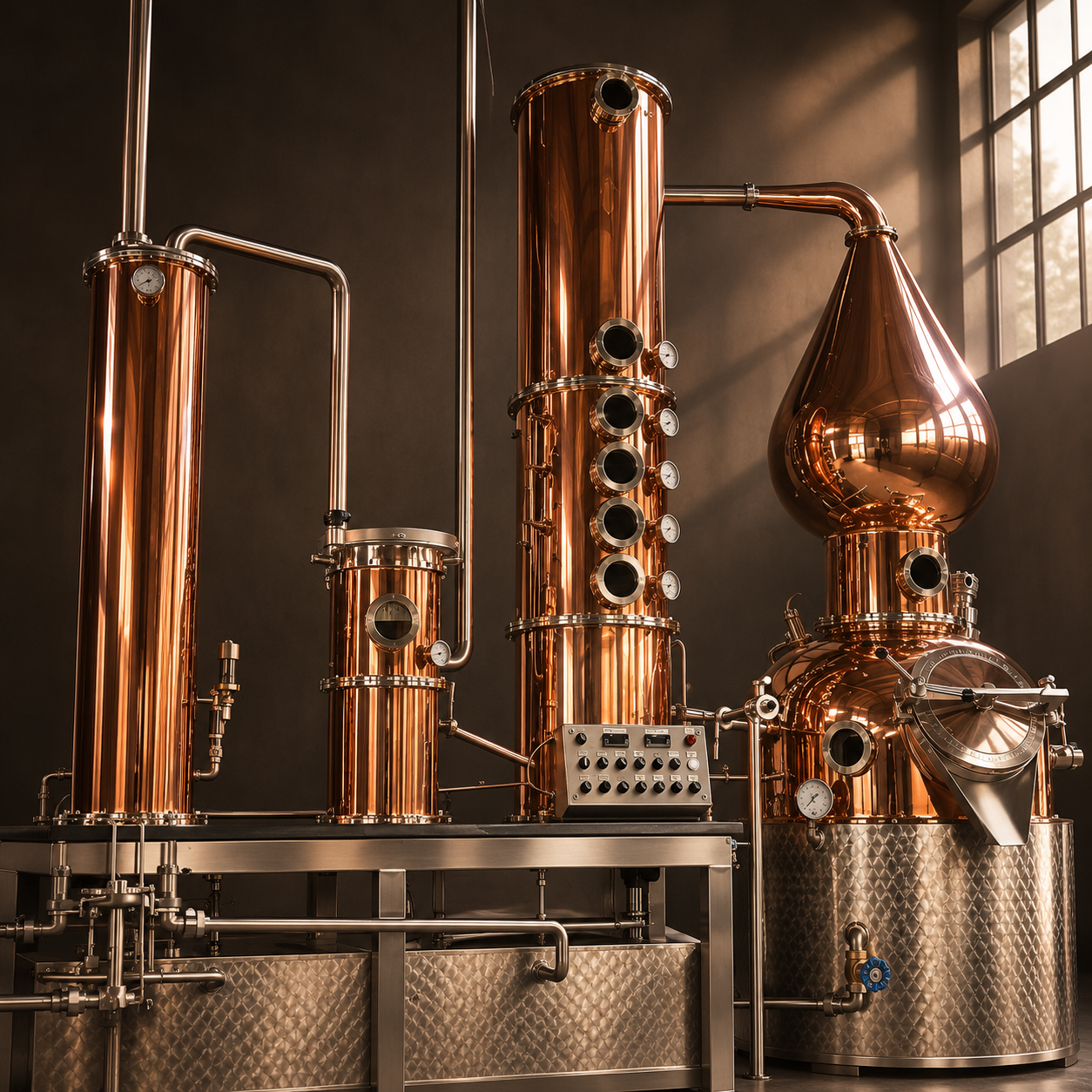
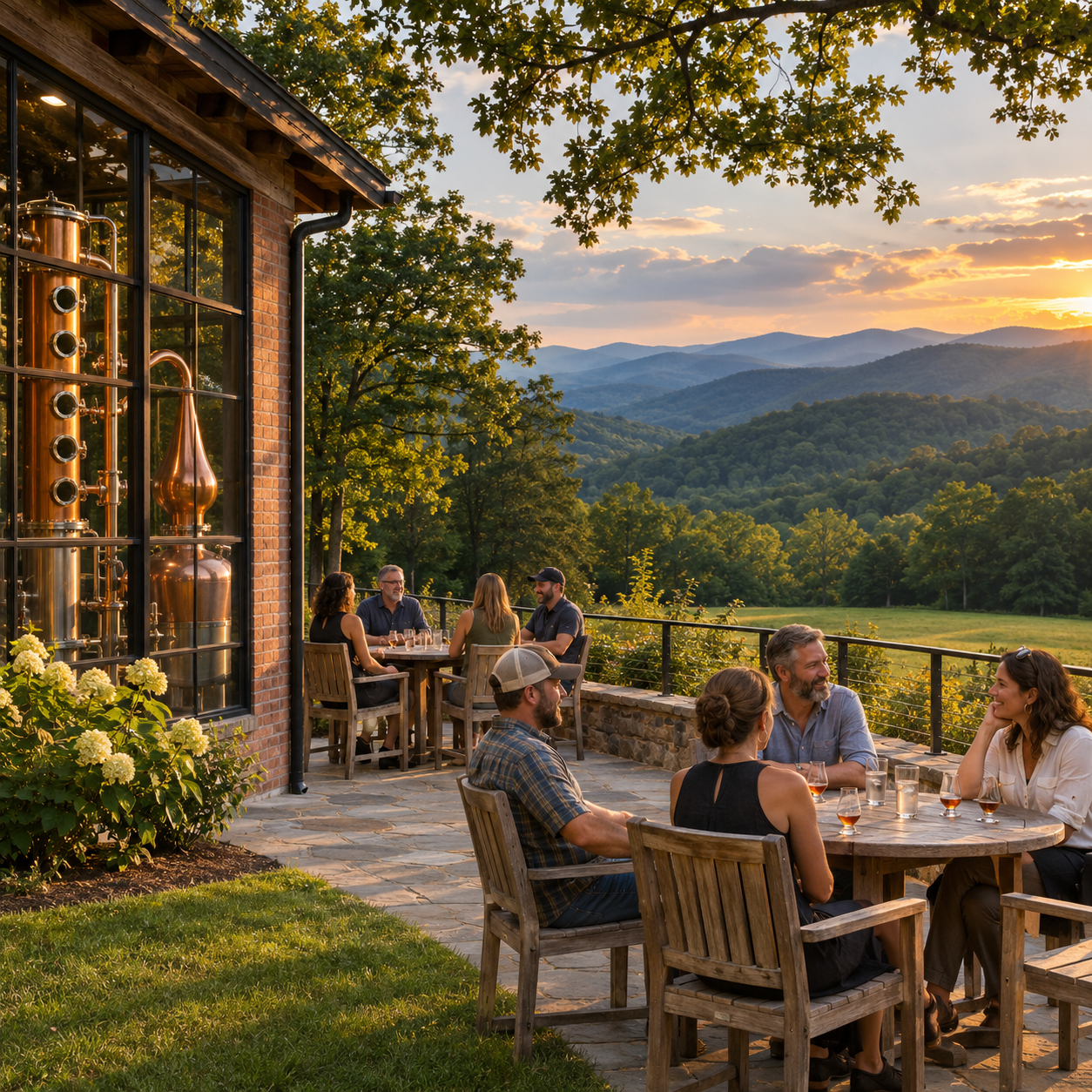
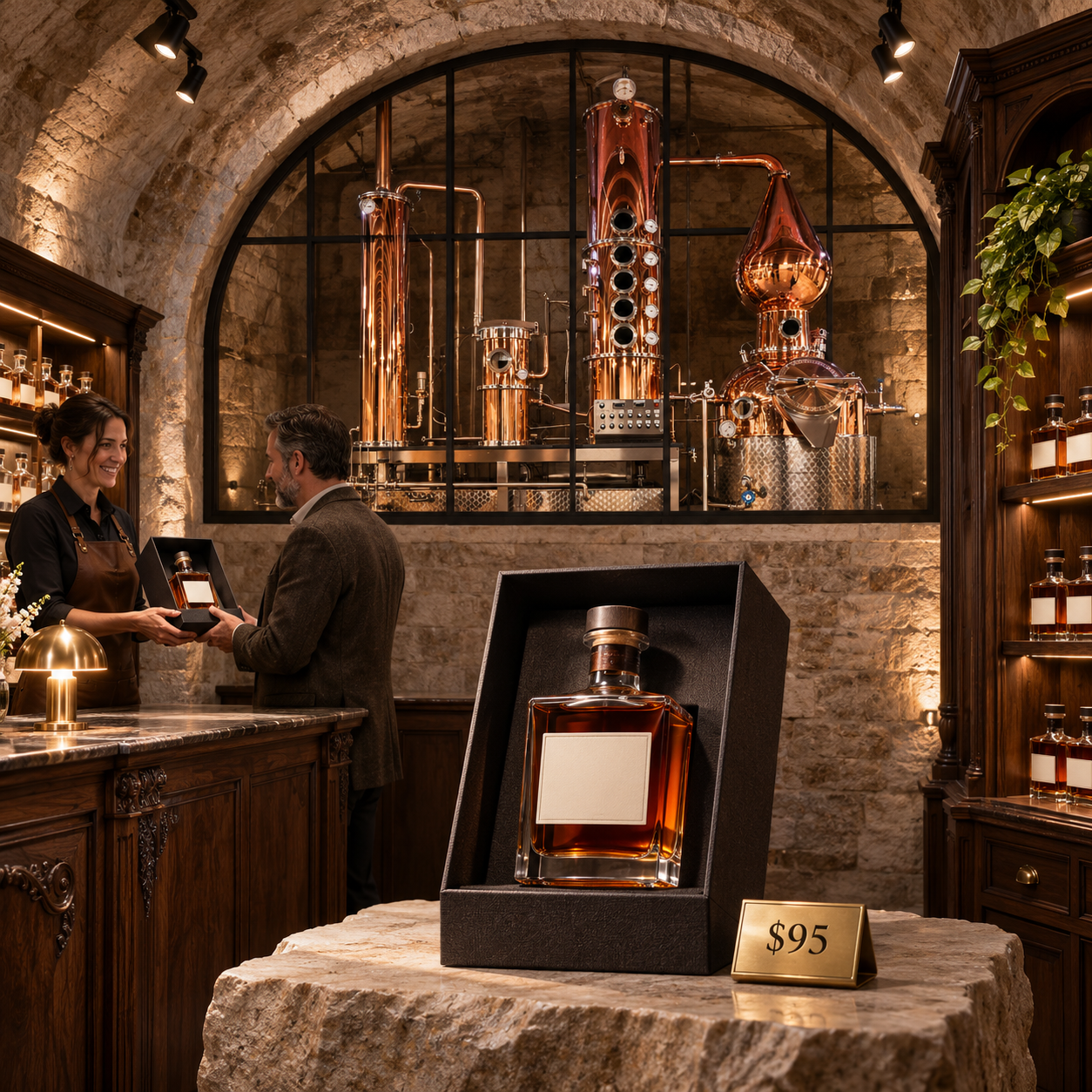
Every distillery has a heart, and it’s the still. Picture a hand-hammered copper pot catching the light, warm to stand near, a faint smell of fruit in the air. That’s what visitors photograph, share, and remember long after the last sip. The still anchors every tour and every story you tell. If your building and codes allow, put it where guests can see it, for example behind a glass wall. Just don’t assume a still in or near a tasting room is allowed: public access, separation from production areas, fire protection, ventilation, and hazardous-location electrical requirements must be approved by your building official, fire marshal, and other authorities. Done right, a still in view turns a production room into a destination.
Pot, column, and hybrid stills: definitions
A pot still is a batch still: you charge the pot with fermented fruit wine or cane wash, heat it, and make your cuts by hand and by nose. A column still distills through a tall column of plates and can reach much higher proof. Many columns run continuously, but some are designed for batch operation. A hybrid still is a pot with an attached rectification column of bubble plates and a dephlegmator, and often an aroma helmet or botanical basket. It can run much like a pot still or like a short column still.
For fruit brandy and characterful rum, many distillers favor copper pot stills for two reasons. Batch distillation at lower proof keeps more of the fruit or cane character, and copper reacts with sulfur compounds formed during fermentation and helps remove them. Lighter styles can call for more rectification.
Which still for which spirit? (general guide; designs vary)
|
Spirit |
Pot still |
Column still |
Hybrid still |
|
Fruit brandy |
Common choice. Keeps fruit aroma. |
Used for lighter styles |
Yes, with plates bypassed or lightly used |
|
Rum |
Full-bodied, heavier styles |
Lighter styles |
Both styles from one still |
|
Gin |
Possible by redistilling a neutral base with botanicals |
Makes the neutral base |
Common. Plates plus a botanical basket. |
|
Vodka |
Not practical (must reach 190 proof) |
Built for it |
Only if the column can reach 190 proof |
|
Best for |
Small batches, maximum flavor |
Volume, high proof, continuous or batch runs |
Startups that want range |
Hybrid pot and column stills: one system, many spirits
A dephlegmator at the top of a hybrid’s column acts as a partial condenser. It controls how much vapor goes forward and how much falls back for another pass over copper. With the plates bypassed or barely used, a hybrid runs much like a classic pot still and can make full-flavored brandy and rum. With the plates and dephlegmator engaged, the same still makes a cleaner, higher-proof spirit you can use as a base for gin. Vodka has a stricter bar: federal rules define it as a neutral spirit distilled at or above 95% ABV (190 proof), so ask the maker whether a particular column can reach that.[32] A well-chosen hybrid can sometimes replace two systems, saving floor space, utilities, and capital, but it isn’t the right answer for every plan.
Financing your equipment, new or used
Fund the business in order: friends and family and your own savings for the early startup equity (see Line Up Capital Before You Commit), then SBA loans and specialized equipment financing for the still and other equipment. The equity you raise first is usually what lenders expect you to put in.
Short answer: yes, both new and used distillery equipment can often be financed, through equipment loans and leases, SBA-backed loans, and in rural areas USDA-guaranteed loans. Lenders look at your credit and business history and at the specific equipment, its condition, and its seller.[51]
- SBA 7(a) loans are the SBA’s main small business loan program and can be used for purposes that include equipment. See the SBA’s 7(a) page.[52]
- SBA 504 loans provide long-term, fixed-rate financing for major fixed assets such as buildings and long-lived machinery and equipment. See the SBA’s 504 page.[53]
- USDA Rural Development: the Business and Industry Guaranteed Loan program guarantees lenders’ loans to rural businesses, and eligible uses include buying and installing machinery and equipment. Ask your lender, or your state’s Rural Development office, whether your location qualifies.[27] Farmer-distillers can also look at the Value-Added Producer Grants in step 9.
Equipment lenders that say they finance distillery or beverage equipment (check each one’s current terms):
- Ameris Bank Equipment Finance (formerly Balboa Capital) has a distillery equipment financing program for new and used equipment, with an online application. It lists minimum requirements, including time in business.[54]
- Crest Capital finances and leases brewery equipment, notes that distilleries use much of the same equipment, and offers tips on buying new and used systems.[55]
- FPG runs a vendor financing program for beverage equipment, including stills, fermenters, and spirits production equipment. It says it finances qualifying used equipment, including auction and plant-closure purchases. Ask your equipment seller whether it offers FPG or similar financing.[56]
- iLease Capital is an equipment finance broker that works with many lenders and arranges financing for new and used brewery and distillery equipment.[51]
AMBRu does not endorse specific lenders. Compare offers. Read the full terms, and make sure any equipment you finance fits your licensed premises and your fire-code plan. Equipment financing covers the hardware, not the working capital you’ll need after opening.
5. Finding Customers and Building a Business
How Will a New Distillery Get Customers?
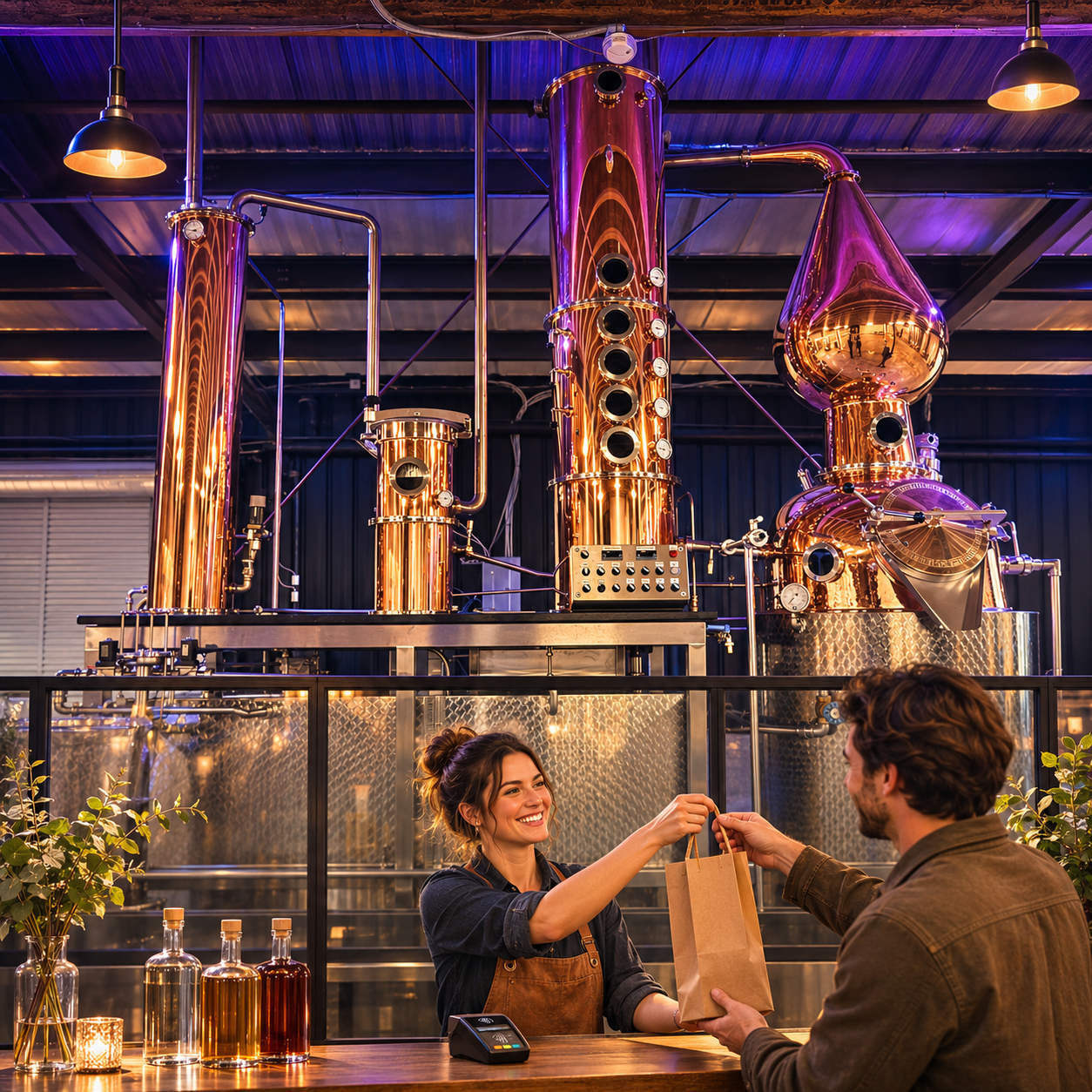
Short answer: For many small craft distilleries, the tasting room is one of the most important sales channels. It offers direct contact with customers, greater control over the visitor experience, and the potential for stronger per-bottle economics than wholesale distribution. It can’t guarantee financial success on its own. Local bars, shops, and distributors usually come later.
The market has been tough. The American Craft Spirits Association’s 2026 Craft Spirits Data Project found that craft spirits declined for a third straight year in 2025, and every sales channel lost volume. Sales at the distillery grew from 14% of craft spirits sales in 2015 to 26% in 2025. That’s a larger share of a shrinking total, not proof that on-site sales volume grew. ACSA called the tasting room a small distillery’s “lifeline.” It noted that more than 40 distillery trails across the country are driving visitors to tasting rooms, and that 41 states prohibit interstate direct-to-consumer shipping of spirits.[10] For most new distillers, the customers you can count on early are the ones who walk in.
Tasting-room vs. wholesale margins
Selling at your own counter can pay better per bottle. ZenBusiness says an on-site tasting room sells at 3 to 5 times the margin of wholesale distribution.[9] TaroStack’s worked example notes that a distributor pays about half the shelf price, and finds that a bottle sold in the tasting room leaves about three times what a distributor bottle does.[57] These are gross, per-bottle comparisons: price minus the cost of what’s in the bottle. They are not net profit. A tasting room also carries staff, opening hours, guest space, insurance, licenses, and marketing, and those costs come out before you see a profit. Treat these industry examples as illustrations, not outcomes you can count on.
What a trail does for a tasting room
The best-documented example is the Kentucky Bourbon Trail. The Kentucky Distillers’ Association reports 2.7 million visitors in 2025, matching its 2024 record, and more than 20 million visits since 1999. About 80% of visitors come from outside Kentucky. Guests stay three to five days on average, and groups spend between $600 and $1,400 per trip on lodging, dining, entertainment, and transportation. The program has nearly 70 participating distilleries, and 95% of visitors said they highly approve of their distillery experience.[58] The KDA’s 2024–2025 economic impact report puts the statewide impact of Kentucky’s distilled spirits industry at $10.6 billion a year.[59]
None of that is a forecast for brandy or rum. But it shows how a trail works. A name people recognize gives travelers a reason to come, and a map gives them somewhere to go. Each distillery on the route can send visitors to the next one down the road. In the words of Recognition to Revenue: “Visitors eat. They stay overnight. They visit farms and historic sites. They shop. They discover another distillery down the road.”[13]
The honest risks
A mentor would tell you this plainly: distilleries close. ACSA counted 2,131 active craft distillers as of August 2026, down 6.6% from 2,282 a year earlier. Craft employment, exports, and investment also fell in 2025.[10] The ADI Forums even have a “Distilleries For Sale” section.[60] Distillery University lists the three mistakes it sees most: signing a lease before the fire marshal and zoning office say yes, planning on aged-spirit revenue in year one, and learning to distill on the production still.[8] Plan for slow early sales, keep working capital in reserve, and treat every number on this page as a starting point for your own research.
Get Found: Put Your Distillery on the AMBRu Trail
AMBRu is building the American Brandy & Rum Trail as a national, producer-led discovery platform connecting American brandy and rum distilleries with the historic places behind them. No trade group or single distillery owns it. The trail is meant to support a sequence AMBRu describes as Recognition → Discovery → Visitation → Economic Opportunity.[12][13]
What exists today: a public BETA map, launched in September 2026, that brings together distilleries and historic sites. AMBRu is open about what it is: “a place to start looking, not a finished trail.” Listings marked Verified are manually reviewed against federal distillery registration or label records, and a listing doesn’t mean AMBRu certifies or endorses a producer or product.[61][62][12]
What’s ahead: AMBRu intends the trail to become the longest distillery trail in the world. That’s a goal, not an independently verified record.[62] The trail framework is designed around regional hubs (Northeast, Mid-Atlantic, South, Gulf Coast, Midwest, and West) so visitors can explore in segments and choose their own route.[63]
An honest note: joining AMBRu and appearing on the map can help travelers find you, but they don’t guarantee customers or sales. Visitors still come for a good spirit, a welcoming room, and a reason to make the trip.
For licensed distilleries (free with an approved DSP):
Join AMBRu Free — Add Your Distillery to the Trail →
For aspiring distillers:
Explore the American Brandy & Rum Trail →
Your Next Step
Build something with your hands that people will travel to see, and build it where the visitors are heading. Joining AMBRu is free for any distillery with an approved DSP. If you hold one, join free with your distillery’s DSP and add your distillery to the trail. If you’re still planning, explore the trail map, read the case for American Brandy & Rum designation and Recognition to Revenue, and follow along. The history isn’t missing. Neither are the people who will carry it forward.
6. Resources, Glossary, FAQs, and Sources
Never Distilled Before? Learn First
How do I become a distiller?
Short answer: take a reputable course, then get real time on a working still at a licensed distillery. You can’t legally practice at home, so formal classes and on-the-job experience are the way in.[3][4] Once you know the craft, you can plan your own DSP.
A few established options (check each school for current dates and tuition; AMBRu doesn’t endorse specific schools):
- Moonshine University (Louisville, Kentucky): a 5-Day Distiller Course plus shorter workshops on fermentation, barrel aging, blending, and distilling operations. Rum pick: it offers a dedicated Rum Workshop.
- Distillery University: 3-day hands-on workshops inside working craft distilleries, self-paced online classes, and certification exams. Brandy and rum: its online library and exams cover both.
- Kothe Distilling Technologies (Chicago): a five-day hands-on Distillery Operations certificate course, plus a three-day workshop that covers fruit selection, fruit mashing, and sensory work with eaux de vie. Brandy pick for fruit distillers.
- Michigan State University: MSU’s artisan distilling work now sits in a research group, and its for-credit course in brewing and distilled beverage technology covers brandy and eau-de-vie production. It’s aimed at enrolled students with a science background, as described in ADI’s Distiller magazine.[64]
- Oregon State University PACE: a Distillery Startup Workshop on the business, legal, and production basics of opening a craft distillery. Check the catalog for new dates.
- Siebel Institute: a five-day Craft Distilling Operations and Technology course covering distillation from grain, fruit, and other materials. The listed session is held in Montreal, Canada.
- Industry associations: ADI events and webinars and ACSA education.
Consider apprenticing on the trail. One of the best teachers is a working distillery. Look up brandy and rum producers on the AMBRu trail map and ask whether they take volunteers, apprentices, or part-time help. Many distillers learned exactly that way.
Glossary
- ABV and proof: ABV is alcohol by volume. U.S. proof is twice the ABV, so 40% ABV is 80 proof.[65]
- Proof gallon: One gallon of liquid at 60°F that is 50% alcohol by volume, or its alcohol equivalent. Federal excise tax is figured per proof gallon.[65]
- DSP (Distilled Spirits Plant): A plant registered with the TTB under 27 CFR Part 19, where spirits may legally be produced, stored, and processed.[6]
- Basic permit: A federal permit under the Federal Alcohol Administration Act (27 CFR 1.21) required to engage in the business of distilling, rectifying, or bottling beverage spirits. It’s separate from DSP registration, and beverage distillers apply for both through Permits Online. Some states, such as Georgia, ask for a copy.[39][6][43]
- Bonded premises: The part of a DSP where spirits are made and stored before tax is paid.
- COLA: Certificate of Label Approval, the TTB’s approval of a distilled spirits label, required before bottling unless the bottler holds a certificate of exemption.[47]
- Certificate of exemption from label approval: A TTB certificate for spirits that will be sold only within one state. The label must say “For sale in [State] only,” and federal labeling rules still apply.[48]
- Formula approval: TTB approval of how a product is made. It’s required before blending, flavoring, or treating spirits in ways that change their character, class, or type, and for gin or vodka made other than by original and continuous distillation.[33]
- Standards of identity: Federal definitions of each spirit class (brandy, rum, gin, vodka, and others) in 27 CFR Part 5.[32]
- CBMA: The Craft Beverage Modernization Act, which set the reduced federal excise tax rates on the first proof gallons a producer removes each year.
- Working capital: The cash a business needs to run day to day: paying for ingredients, packaging, labor, taxes, and fixed costs before customers pay.
- Wash: The fermented liquid that goes into the still. For brandy it’s fruit wine. For rum it’s fermented cane juice, syrup, or molasses.
- Pomace and stillage: Pomace is the leftover fruit solids from pressing. Stillage is what’s left in the still after a run. In rum making, stillage is often called dunder.
- Heads, hearts, and tails: The three parts of a spirit run. Heads come first and contain the most volatile compounds, hearts are the clean middle you keep, and tails come last and are heavier. Choosing where to divide them is called making cuts.
- Pot still: A batch still with a pot, a head or helmet, and a condenser.
- Column still: A still that distills through a tall column of plates. Many run continuously; some are designed for batch operation.
- Hybrid still: A pot with an attached rectification column, a dephlegmator, and often an aroma or botanical option. It can run much like a pot still or like a short column still.
- Rectification plates (bubble plates): Trays inside a column. Each plate acts like another small distillation, raising proof and cleaning up the spirit.
- Dephlegmator: A partial condenser at the top of a column that sends some vapor back down for more refinement.
- Eau-de-vie: A common name for clear, unaged fruit brandy. On U.S. labels it still follows the fruit brandy naming rules, such as “pear brandy.”
- Applejack: A name federal rules allow for apple brandy.[1]
- Immature brandy: Grape brandy stored in oak for less than two years must be labeled “immature grape brandy” or “immature brandy.”[1]
- Neutral spirits: Spirits distilled at or above 95% ABV (190 proof). Vodka is a type of neutral spirits.[32]
- NFPA 30: The National Fire Protection Association’s Flammable and Combustible Liquids Code, widely used in local fire codes.[35]
- Conditional use permit and certificate of occupancy: Local approvals. The first lets a use, such as a distillery, operate in a zone under conditions. The second confirms a building is safe to occupy.
Frequently Asked Questions
Why brandy or rum instead of bourbon?
Bourbon is a mature, crowded category led by long-established producers. American brandy and American rum are just as old, but they still have no distinctive U.S. product identity like the one Congress gave bourbon in 1964. AMBRu is a producer-led campaign seeking that recognition, which may come through a different legal or regulatory path than bourbon’s and has not been granted. A new distiller who starts now can help shape the category and its trail, but recognition would not by itself guarantee customers or sales.
Does it cost anything to join AMBRu?
No. Joining AMBRu is free for any distillery with an approved TTB Distilled Spirits Plant (DSP). Create an account at ambru.org/register/ and add your distillery to the trail map.
How much does it cost to start a brandy or rum distillery?
More than most first plans assume. ZenBusiness estimates $500,000 to $1.5 million to open a commercial craft spirits distillery and 24 to 48 months to break even. Distillery University says a small craft distillery typically needs several hundred thousand dollars to open and that a tasting-room build-out in leased space often passes $1 million. These headline figures often leave out site and utility work, fire and code compliance, installation, packaging, working capital, aging inventory for brandy or rum, and the years before profit. Build your own line-by-line budget and fund opening and operating through at least year two.
When should I line up financing and investors for a distillery?
Before you sign a lease, order equipment, or file with the TTB. Start with a business plan and a realistic budget that includes working capital and operating cash through at least year two. Then secure written equity commitments, usually starting with your own savings and friends and family, and get a lender’s pre-approval for SBA or equipment financing. Only then commit to the site, the equipment orders, and the permits. Lenders expect owners to put in their own money; for an SBA 504 project, a business operating two years or less must contribute at least 15% of project costs.
Should I raise money from friends and family for a distillery?
Friends and family are often the first outside investors in a new distillery. Put the terms in writing, including whether it is a loan or equity, share the same plan and forecast you would give a bank, explain plainly that they could lose the money, and only take money people can afford to lose. Selling equity or convertible notes is generally an offer of securities, so it must be registered or fit an SEC exemption; talk to a securities attorney first.
How much working capital does a new distillery need?
There is no reliable industry average; it depends on your products, sales channels, and payment terms. Budget for opening inventory plus several months of operating cash for the tasting-room launch: ingredients, packaging for the next run, excise taxes, rent, payroll, utilities, and insurance until sales cover them. If you add wholesale, also budget for the next production run while you wait to be paid for the previous delivery. A distillery can be profitable on paper and still run short of cash.
How long does it take to open a distillery?
Distillery University says 12 to 24 months from decision to first sale is normal. The TTB’s median time to approve an original Distilled Spirits Plant application was 37 calendar days in October 2026, but site work, state and local licenses, build-out, and equipment delivery usually take much longer.
Can I distill at home?
No. Federal law prohibits producing distilled spirits at home, even for personal use. Spirits may only be produced at a distilled spirits plant registered with the TTB, and illegal distilling can bring serious federal penalties.
Can I finance used distillery equipment?
Often, yes. Equipment loans and leases from lenders that serve the beverage industry, SBA 7(a) and 504 loans, and in eligible rural areas USDA Business and Industry guaranteed loans can all be used for equipment, including qualifying used equipment. Approval depends on your credit, your business, and the specific equipment and seller. AMBRu does not endorse specific lenders; compare offers.
Do I need a federal permit to make brandy or rum?
Yes. You must register your Distilled Spirits Plant (DSP) with the Alcohol and Tobacco Tax and Trade Bureau (TTB), and a business that distills, rectifies, or bottles beverage spirits also needs a federal basic permit under the Federal Alcohol Administration Act. You apply through TTB’s free Permits Online system. You will also need state and local approvals, which vary by state.
Do I need label approval (a COLA) for every product?
Not always. A bottler needs a federal Certificate of Label Approval (COLA) before bottling spirits that will be sold in interstate or foreign commerce. If a product will be sold only within your state, you can apply instead for a certificate of exemption from label approval, and the label must say “For sale in [State] only.” Either way, labels must still meet federal labeling rules, and your state may have its own requirements.
Can a tasting room really carry a small distillery’s sales?
It is one of the most important channels, but not a guarantee. The American Craft Spirits Association’s 2026 Craft Spirits Data Project found that on-site sales grew from 14% of craft spirits sales in 2015 to 26% in 2025. That is a rising share during a period when volume fell in every channel, not proof of growing sales. What you may sell on site depends on your state’s laws, and a tasting room carries its own costs.
What is the legal difference between brandy and rum in the U.S.?
Under federal standards of identity, brandy is distilled from the fermented juice, mash, or wine of fruit, or from its residue, while rum is distilled from the fermented juice of sugar cane, sugar cane syrup, sugar cane molasses, or other sugar cane by-products. Both must be distilled at less than 95 percent alcohol by volume and bottled at not less than 40 percent alcohol by volume (80 proof).
Is apple brandy the same as applejack?
Federal labeling rules allow apple brandy to be designated as applejack. Fruit brandies other than grape brandy are named for their fruit, such as peach brandy or pear brandy.
Should I buy a pot still or a hybrid still?
No single still is best for every brandy or rum. A copper pot still is a common choice for full-flavored brandy and rum. A hybrid still adds a rectification column with plates and a dephlegmator to a pot, so the same system can run much like a pot still or produce a cleaner, higher-proof spirit for bases such as gin. Choose based on the styles you want, your fermentation volume and batch size, target proof, operating costs, available utilities, and future plans. If you plan to make vodka, confirm with the manufacturer that the column can reach the 95 percent ABV federal minimum for neutral spirits.
How does the AMBRu trail help a new distillery get found?
AMBRu is building a national, producer-led American Brandy & Rum Trail. Today it is a public BETA map of brandy and rum distilleries and historic places. A listing helps travelers looking for these spirits find you, but it does not guarantee visitors or sales, and it does not mean AMBRu certifies or endorses a producer or product.
Sources
- 27 CFR 5.145, Brandy, eCFR. https://www.ecfr.gov/current/title-27/section-5.145
- 27 CFR 5.147, Rum, eCFR. https://www.ecfr.gov/current/title-27/section-5.147
- 27 CFR 19.51, Home production of distilled spirits prohibited, eCFR. https://www.ecfr.gov/current/title-27/section-19.51
- TTB, “Home Distilling” (penalties for illegal distilling). https://www.ttb.gov/regulated-commodities/beverage-alcohol/distilled-spirits/penalties-for-illegal-distilling
- TTB, “Distilled Spirits Permits”. https://www.ttb.gov/regulated-commodities/beverage-alcohol/distilled-spirits/permits
- 27 CFR 19.71, Registration and permits in general, eCFR. https://www.ecfr.gov/current/title-27/section-19.71
- TTB, “Processing Times for Original Permit Applications” (page last updated October 19, 2026). https://www.ttb.gov/nrc/statistics-original-applications-to-operate
- Distillery University, “How to Start a Distillery”. https://distilleryuniversity.com/how-to-start-a-distillery/
- ZenBusiness, “How to Start a Craft Spirits Distillery” (last updated September 28, 2026). https://www.zenbusiness.com/start-a-business/food-service/craft-spirits-distillery/
- American Craft Spirits Association, “2026 Craft Spirits Data Project Results Are In,” October 7, 2026. https://americancraftspirits.org/2026-craft-spirits-data-project-results-are-in-craft-spirits-decline-for-third-straight-year-in-2025/
- S. Con. Res. 19, 88th Congress, agreed to May 4, 1964, 78 Stat. 1208 (GovInfo). https://www.govinfo.gov/content/pkg/STATUTE-78/pdf/STATUTE-78-Pg1208.pdf
- AMBRu Campaign, homepage (campaign status and disclaimers). https://ambru.org/
- AMBRu Campaign, Recognition to Revenue, Working Paper No. 1, September 2026. https://ambru.org/recognition-to-revenue/
- TTB, “TTB Establishes ‘American Single Malt Whisky’ Standard of Identity” (final rule published December 18, 2024, effective January 19, 2025). https://www.ttb.gov/public-information/featured-stories/ttb-establishes-american-single-malt-whisky-standard-identity
- AMBRu Campaign, “American Brandy and Rum: The Question of Designation”. https://ambru.org/ambrus-plan-to-win-designation-for-american-brandy-and-rum/
- John Adams to William Tudor Sr., August 11, 1818, via the Massachusetts Historical Society. https://www.masshist.org/beehiveblog/2013/01/three-centuries-of-molasses-in-massachusetts/
- “The Story Behind Laird & Company, Our Country’s Oldest Distillery,” New Jersey Monthly. https://njmonthly.com/articles/eat-drink/laird-and-company-oldest-distillery/
- World Economic Forum, Future of Jobs Report 2025, “Jobs outlook,” January 2025. https://www.weforum.org/publications/the-future-of-jobs-report-2025/in-full/2-jobs-outlook/
- Booking.com, Travel & Sustainability Report 2025 (32,000 travelers, January 2025). https://news.booking.com/download/487ae9ae-97ef-4f66-b368-3b71787677b6/2025travelampsustainabilityreport-booking.com2.pdf
- Moonshine University, “Start Building Your Distillery”. https://www.moonshineuniversity.com/media/start-building-distillery
- TTB, “Tax Rates” (distilled spirits, 2018 to present). https://www.ttb.gov/taxes/tax-audit/tax-and-fee-rates
- U.S. Small Business Administration, “Write your business plan” and “Calculate your startup costs”. https://www.sba.gov/business-guide/plan-your-business/write-your-business-plan
- U.S. Securities and Exchange Commission, “Early-Stage Investors” (friends and family, angel investors, and venture capital funds), June 12, 2024. https://www.sec.gov/resources-small-businesses/capital-raising-building-blocks/early-stage-investors
- U.S. Securities and Exchange Commission, “Exempt Offerings”. https://www.sec.gov/resources-small-businesses/exempt-offerings
- 13 CFR 120.910, Borrower contributions (SBA 504), eCFR. https://www.ecfr.gov/current/title-13/chapter-I/part-120/subpart-H/subject-group-ECFRc64be25e87f1150
- U.S. Small Business Administration, SOP 50 10, Lender and Development Company Loan Programs (version 8.1 effective October 1, 2026). https://www.sba.gov/document/sop-50-10-lender-development-company-loan-programs
- USDA Rural Development, “Business and Industry Guaranteed Loan”. https://www.rd.usda.gov/programs-services/business-programs/business-industry-loan-guarantees
- USDA Rural Development, “Value-Added Producer Grants”. https://www.rd.usda.gov/programs-services/business-programs/value-added-producer-grants
- CDFI Fund, U.S. Department of the Treasury, “CDFI Certification” and list of certified CDFIs. https://www.cdfifund.gov/programs-training/certification/cdfi
- U.S. Securities and Exchange Commission, “Regulation Crowdfunding”. https://www.sec.gov/resources-small-businesses/exempt-offerings/regulation-crowdfunding
- 27 CFR 1.42 and 1.44, Change in ownership, management, or control; automatic termination of permits, eCFR. https://www.ecfr.gov/current/title-27/section-1.42
- 27 CFR Part 5, Standards of Identity (brandy § 5.145, rum § 5.147, gin § 5.144, neutral spirits/vodka § 5.142), eCFR. https://www.ecfr.gov/current/title-27/chapter-I/subchapter-A/part-5
- 27 CFR 19.348, Formula requirements, eCFR. https://www.ecfr.gov/current/title-27/section-19.348
- TTB, “Distilled Spirits Plant (DSP) Required Documents”. https://www.ttb.gov/online-services/permits/permits-rd/distilled-spirits-plant
- NFPA 30, Flammable and Combustible Liquids Code. https://www.nfpa.org/codes-and-standards/nfpa-30-standard-development/30
- OSHA, 29 CFR 1910.106, Flammable Liquids. https://www.osha.gov/laws-regs/regulations/standardnumber/1910/1910.106
- OSHA, “Combustible Dust: An Explosion Hazard”. https://www.osha.gov/combustible-dust
- 27 CFR Part 19, Distilled Spirits Plants, eCFR. https://www.ecfr.gov/current/title-27/chapter-I/subchapter-A/part-19
- 27 CFR 1.21, Basic permits for domestic producers, rectifiers, blenders, and warehousemen, eCFR. https://www.ecfr.gov/current/title-27/section-1.21
- TTB, “Processing Times for Label Applications” (chart updated November 16, 2026). https://www.ttb.gov/regulated-commodities/labeling/processing-times
- TTB, Formula processing times (chart updated November 16, 2026). https://www.ttb.gov/regulated-commodities/formulation/fonl-processing-times
- Virginia ABC, “Distillery” license page. https://www.abc.virginia.gov/licenses/val/definitions/distillery
- Georgia Department of Revenue, “Distillery (In-State)”. https://dor.georgia.gov/distillery-state
- Georgia Department of Revenue, “General Alcohol & Tobacco Questions”. https://dor.georgia.gov/general-alcohol-tobacco-questions
- Oregon Liquor and Cannabis Commission, “Liquor Licensing FAQs”. https://www.oregon.gov/OLCC/LIC/pages/faqs_liquor_licensing.aspx
- West Auctions, “Distillery Equipment Auctions”. https://www.westauction.com/category/distillery-equipment
- 27 CFR 5.21 and 5.22, Certificates of label approval for distilled spirits bottled in the United States, eCFR. https://www.ecfr.gov/current/title-27/section-5.21
- 27 CFR 5.23, Exemption from label approval, eCFR. https://www.ecfr.gov/current/title-27/section-5.23
- TTB, “Distilled Spirits Labeling”. https://www.ttb.gov/regulated-commodities/beverage-alcohol/distilled-spirits/labeling
- TTB, “Beverage Alcohol Manual” for distilled spirits (TTB notes it has not been updated for the current 27 CFR Part 5 rules). https://www.ttb.gov/regulated-commodities/beverage-alcohol/distilled-spirits/beverage-alcohol-manual
- iLease Capital, “Used Brewery & Distillery Equipment Financing Guide”. https://ileasecapital.com/resources/brewery-distillery-equipment-financing
- U.S. Small Business Administration, “7(a) loans”. https://www.sba.gov/funding-programs/loans/7a-loans
- U.S. Small Business Administration, “504 loans”. https://www.sba.gov/funding-programs/loans/504-loans
- Ameris Bank Equipment Finance, “Distillery Equipment Financing”. https://equipmentfinance.amerisbank.com/distillery-equipment-financing/
- Crest Capital, “Brewery Equipment Lease Finance”. https://www.crestcapital.com/catalog/general-equipment-financing-brewery-equipment-financing
- FPG, “Beverage Production Equipment Vendor Financing”. https://www.financialpc.com/beverage-equipment-vendor-financing
- TaroStack, “Distillery Business Plan” (worked example). https://www.tarostack.com/articles/distillery-business-plan
- Kentucky Distillers’ Association, “Kentucky Bourbon Trail Visitation Holds Strong at 2.7 Million Hosted in 2025,” April 7, 2026. https://kybourbon.com/industry-news/kentucky-bourbon-trail-visitation-holds-strong-at-2-7-million-hosted-in-2025/
- Kentucky Distillers’ Association, The Economic and Fiscal Impacts of Kentucky’s Distilled Spirits Industry, 2024–2025, February 2, 2026 (PDF). https://kybourbon.com/wp-content/uploads/2026/02/FINAL-KDA-Economic-Impact-Report-2.2.26.pdf
- American Distilling Institute Forums (marketplace and “Distilleries For Sale” section). https://adiforums.com/
- AMBRu Campaign, “AMBRu Launches BETA of the American Brandy & Rum Trail,” September 22, 2026. https://ambru.org/ambru-launches-beta-of-the-american-brandy-rum-trail/
- AMBRu Campaign, “Explore the American Brandy & Rum Trail” (BETA map). https://ambru.org/map/
- AMBRu Campaign, “American Brandy & Rum Trail”. https://ambru.org/american-brandy-rum-trail/
- Distiller magazine (ADI), “Spiritual Training: How to Get a Formal Education in Distilled Spirits”. https://distilling.com/distillermagazine/spiritual-training-how-to-get-a-formal-education-in-distilled-spirits/
- 27 CFR 19.1 (definitions, including proof and proof gallon), eCFR. https://www.ecfr.gov/current/title-27/section-19.1
This page offers general information, not legal, financial, or regulatory advice. Figures cited describe published estimates and established spirits industries and trails. They are not forecasts or promises for any distillery, for American Brandy or American Rum, or for the AMBRu trail. Federal, state, and local requirements change, so confirm current rules with the TTB, your state alcohol authority, and your local officials. AMBRu does not certify spirits or set federal standards, and as of September 2026 has not filed a TTB petition.

Author: caro
Caroline Porsiel is co-founder of the AMBRu Campaign and author of the Recognition to Revenue framework, working to advance recognition of American Brandy and American Rum and build a national American Brandy & Rum Trail.